Book Proposal Salvo 2.1

I wanted to take a moment and write a quick blog post about what I have been up to and explain the unannounced silence. For the last week I have been in the midst of a redraft. I sent in my chapter and proposal to the acquisitions editor last week and I was asked to send more chapters. It wasn’t because it blew his socks off but because more of my writing was needed for a sound evaluation.

Over the last week or so I have been rewriting and cutting, as I planned to do, in order to send back seven more chapters. It has been a fantastic adventure to wade this deeply into my story once again and see what is there. I was surprised to find some parts better than I expected and others much much worse. I am excited to send the chapters and take a long deserved break from staying up until 1 in the morning and getting up early (at times) to continue slogging along.

This edit sprint has helped me become a better writer. It has also caused me to fall in love with my story again and want to make to see it in print that much more. I will share what I have learned when I am done, hopefully tomorrow.

Keep writing my friends. I will keep you posted.

Cheers,

Bob


The Lives of Characters

The last few weeks writing has been replaced with meticulous editing. I will send chapters off to friends shortly and that goal is a marker that helps me stay focused. However, there are many instances that I run out of steam and I find it hard to come back to the chapter again. After nine revisions of one single chapter, the thrill of finishing is long gone. It is replaced with a long laborious haul. Writing is hard work.

When I started writing my novel I knew that it was the beginning of a series. During the planning process I wrote out the lives of each character. Some would die, some would mature. Some would fall in love, and others would search for loved ones and give up hope. These are the things I am excited to share with my readers and why I decided to write in the first place.

At this point of the editing process it is not the thought of completing the book that drives me.  Rather my character’s dreams and hopes that pull me onward and cannot be silenced. They push themselves to the forefront of my mind and interrupt my day. I think of them while driving or walking of spending time with my family. They are in the driver’s seat begging me to continue, for they want to live.

I write this post because many writers have said at some point characters begin to write themselves as if alive. I thought it hogwash and some silly artist nirvana. Now I understand. Custo, Hailea, Sapien, Maero, Comitis, Nimrodur, Elidur, Lenis, Camilla, and the rest of you. I will finish. Be patient with me.

Cheers,

Bob

Remembering the 3-Day Novel Contest

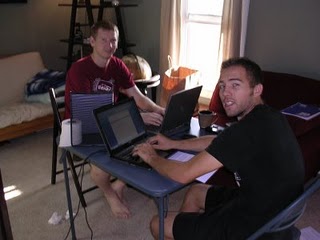
The Weaklings – Our Photo For The Grand Rapids Press

It started out as the most outrageous statement I had ever heard. “So we need to try this sometime. Can you imagine writing a novel in three days?” thus said Matthew Landrum as he discovered the annual 3-Day novel contest over Labor Day Weekend. I took it as a sort of joke at first. After all I had been working on a novel for three stinking years. There was no way I could do that, I thought. Could I?

Then I was creating an outline. My writer’s group The Weaklings (a play on C.S Lewis’s and Tolkien’s Inkings) began to discuss logistics. Where would this take place? What would we eat? How long would we have to write to complete it? What would we write? Slowly but surely each member looked at this Mount Everest of novel writing contests and began to believe that it was something we could finish.

The three day novel contest is exactly that: Start at 12:01am on Saturday and write until 11:59 on Monday evening. You cannot type a single word before or after that time frame and a person must sign and date a form saying you have not. Outlines are okay, but other than that, its just dreaming up as much of the novel in your mind ahead of time before you begin.

Obviously the novels composed during this weekend are not your average novels. No eight hundred page tomes are penned, but eighty to 100 pages are within reach if you are prepared.

The 3-Day Novel is a juggernaut. Once you are in it there is no stopping. And after that brief moment of despair or trying something new you cannot allow yourself to think twice about it, you must highlight, delete, then begin a new sentence in one continuous action.

Through the contest we went on walks, shared the occasional meal, and for motivation I called my wife, talked with a fellow Weakling for a moment or read the article that made it into the Grand Rapids Press and on the Mlive website.

During the two years I did compete, I wrote two novels. The first is titled For the Glory of Nequam. It is my attempt at exploring the evil in my world and how it began. It is the story of a promised young boy who seeks fame, fails and then attempts to restore the glory of his city no matter the cost. 

The second novel is titled Dacia. It’s about a language expert who is commissioned to travel to Romania to help sway them to join England’s cause during WWI. He falls in love with Katia, a native Romanian and after she goes missing while hiking, discovers a society of werewolves that have lived in the Balkans for centuries.

The contest was so much fun that I am getting filled with the thrill of competing in it once more. Not this year though, but perhaps next. Now I am focused on getting published.

Please enjoy other 3 Day Novel memories below:

If you are participating this year, good luck!

Cheers,

Bob

What Makes A Good Story Good?

What makes a story good? If you surveyed your reading friends you would probably get many different answers:

  • Characters
  • Time Period
  • Author’s voice/writing style
  • Action
  • Plot points
  • Topic
  • Because of the person who wrote it

The list could go on and on and chances are you thought of many more reasons why a story is good. This question and its answer is of particular interest to the novelist. We authors write because we like to write, simple as that. But what if our work comes to nothing? Not that is has to be a best seller or even published for that matter, but we at least want our work to be solid and relevant, right?

So I have created a survey below to ask you what makes a story good and why you would be compelled to recommend it to others.

If your reason is not included in the poll, please select “other” and elaborate below.

Cheers,

Bob

How Does a Writer Measure Progress?

Every now and then I look back on the Unmentionables that are my first drafts. I see the path of my writing and, though it has sloped a little way up the hill of mastering the craft, I see I have come a long way.

As I thought about this more, I wondered. So, if I have come “far”, how does a writer measure that exactly? Better yet, How do I, as a writer, measure progress?

The answer for you could be simple. It could be that you now have 30,000 words, and you had 5,000 a year ago. It could be that your vocabulary has grown tremendously, that your scenes of harrowing danger and swashbuckling duels are now believable, or that your love scenes are now devoid of most of their cheesiness.

I believe it is a smattering collection of these things. I see that my writing is cleaner. I see that I don’t use that that often, (pun intended). My words are more diverse and the dialogue is smoother.  However, I am at a loss. I know writers learn by doing. They learn by mastering the craft in order to abide by the laws and break them at their will.

But, How do you measure the progress of your writing?

Keep Writing,

Cheers,

Bob

The Dust Jacket of Calelleth

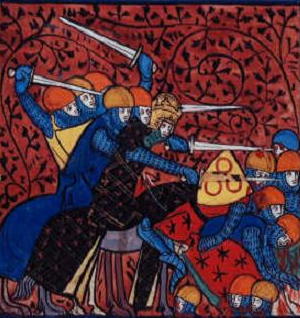
The Seige of Calelleth

Yesterday (see here), I promised to post the synopsis of my book as I continue to work through sections of my proposal. I am pleased to say I got a bit closer to the place I wanted to be, though there is always a (perhaps obsessive) need for the writer to refine and improve.

I have to admit I was a bit depressed by the perpetual mustering of strength  my synopsis required. I was trying so hard and focusing all of my energy on writing a synopsis that is good and gripping and inviting that I nearly tired of writing altogether.

Now, I know it is only a couple of hundred words but I am proud of them. Proud enough to hope that the thrill of finishing this portion of my proposal will be able to carry me through the next. I also hope it offers a potent enough spell to banish that depressive Bob that rears his ugly head every now and again to tell me I’m not cut out for this. You can go to seed, dear friend. This novelist no longer needs you.

Custos is a Humili – both farmer and volunteer in the Calellethian guard. Though war hasn’t happened for centuries, opportunities abound for a young man to display his talent with the sword and bow during the Harvest Celebration. However, before Custos is able to participate, he is chosen to fill a revered post that becomes available once in a generation: The Guardian, the protector of the future Sage of Calelleth.  

After Hailea is elected Sage in Waiting, but before the people of Calelleth discover they are not alone in the world, she befriends her bodyguard Custos and together they uncover a nasty secret buried beneath the city: a labyrinth of passageways leading to ancient ruins and piles of decayed bodies.

As Custos and Hailea struggle with the gravity of this discovery amid the political squabbles and backstabbings that usually encompass their daily life, an innumerable army arrives at the Calellethian gates demanding to have their captive families released to the utter bewilderment of the city leaders.

Will Custos and Hailea be able to devise a plan to appease the ferocious force in order to save Calelleth? Or will the city of Calelleth and its inept army be obliterated by the consequences of a forgotten past?

Keep Writing.

Cheers,

Bob

What Is Your Novel About?

I am having trouble coming up for the synopsis for my book. Funny right? I am the author and even I don’t know what my book is about. It’s not that. It’s just I am having trouble with finding out where my synopsis begins.

My story is one of suppressed histories and nasty secrets that eventually come back to haunt the characters in my book. So, I thought, I should start with the secrets. No, I don’t want to give too much. Should I start with the discovery of the secrets? No, I want that to happen during my novel and not giving it away in its explanation.

I’ve written about twenty drafts of my synopsis. All of them are terrible. I was sitting down in despair because this is a huge part of the proposal. It has to be good enough to capture the agent or reader to spurn them on and create an appetite to continue reading.

My wife eventually said why not start with a quote from my book, something a character says? Or why not start with the beginning of this novel only? I know it seems simple, and it was. Thanks to her I have a great start on description and I will finish it and post it tomorrow.

How about you? Are you having trouble with any particular portion of your proposal? If you’ve written one, what was the most difficult part?

Keep Writing.

Cheers,

Bob

How To Write A Book Proposal

I promised, back at the beginning of the month, to send out a proposal to an agent. I feel unprepared, like a parent sending their child off to kindergarten for the first time. However, it must be done, eventually. I am a writer after all and this is, inevitably, the next step.

But, how do you construct a book proposal? How do you prepare your little beauty to step out of the nest with confidence?

As you might very well know, there are many ways to publish and I plan to try the Mount Everest of them–traditional publication.

The following is advice on, and an outline of, a basic book proposal. You might ask when is the appropriate time to write one of these and the answer is two fold. Non-fiction proposals can be both before and after the book is finished, but for Fiction there is no wiggle room. You must have a completed novel before sending in the proposal.

Please keep in mind that each agency, agent, and publisher, might have different criteria of what they need. Please see their submission guidelines before submitting. Also, do your research. Don’t spend your time sending your thrilling space odyssey novel to a nature magazine. Know who you are submitting to in order to find out what they usually publish. Otherwise, all of your time and mental strain over your proposal is for naught.

I. Overview

This is your elevator pitch. In two or three paragraphs write the synopsis of your book, What is this book about? This might be the only time you have the attention of an agent or editor so make them beg for more. Having trouble knowing how to write one? You can find examples of these on the back of nearly every book. Also, bounce ideas off your writer friends.

II. Target Audience

Who is the audience? Is it a children’s book? Is it a YA novel? Is it a picture book? Is there a market for it? If your work can reach a secondary audience name them as well. Basically, name all parties that might be interested in this book. Don’t be bashful, but be realistic. Your grandma will probably not be interested in your book on Weapons of the World.

III. About the Author

This is your time to shine. Who are you? What is your experience or credentials? Do you have a blog or twitter following? Do you have another platform? One thing to be encouraged by is if you are a first time author there are agencies that are looking especially for first time novelists. You don’t have to have 300 short stories published for someone to read your work. Though, it wouldn’t hurt.

IV. Competition

If there is an audience, what other books are currently reaching them? Please do not say you are writing a YA book that reaches the EXACT SAME audience as Harry Potter. While it may be true, it draws unfair comparisons. Know other books that might be in closer competition.

If you are writing a Romance novel, read the back of every romance novel in your local bookstore then write down the ones that sound similar to yours. After this, go home and research them until you are the expert in what is selling, and how you can do better.

V. Marketing and Promotion

Unfortunately, authors are expected to do more for their sales in recent years, especially if they want to be successful. This means speaking engagements. This means book signings and radio or television appearances and interviews in the local paper or your favorite magazine.

This might sound both intimidating and presumptuous. The best place to start might be an author you know who has experience in these sorts of things. If not, ask the local bookstore manager how authors do book signings and even go to a few of them yourself. Then check at the library to find out what you need to do to get some talking time there. Also, if there is a local radio station or university that owns a radio station or television spot, call and talk with them.

Don’t forget your blog, Twitter account, Facebook, and any other social media/writing outlet you might utilize. All can be used for the promotion of your book.

VI. Sample Chapters

I don’t think I need to say a whole lot about this but the particular agency where you are sending your novel may have certain criteria. It might be the first two, three, or five chapters or merely a few of the best chapters in your book. Read the guidelines carefully and do EXACTLY what they say.

In conclusion, the one thing I would like to stress the most if I have not already is, be sure you follow the rules! Don’t deviate. Don’t be “creative” or try to stand out. Don’t reformat your proposal using cute font. Be professional and serious, no rose perfumed parchment. I don’t know how many times I have read or listen to an interview with an agent that said the reason a lot of novels are disqualified is because they are either not good, or don’t follow the directions in the submission process.

It’s Friday, (WOOHOO!!!) and this means there is only one more week to go on my self-imposed book proposal deadline so I had better get cracking. If you are ready to do the same, good luck my friend.

Cheers,

Bob

Show Me the Story! – Writing Tips

Show don’t tell.

There are things in life that need to be chewed on for some time before the light bulb comes on and we enter the realm of understanding. Showing and not telling is one of the things that took a while for me to understand. Since the light bulb has come on, my writing has not been the same.

But what does this mean? Let me give you an example.

“Charlie was furious”.

This is a line you might come across in your own writing, or at least phrases like this. These phrases describe a scene, but fall unequivocally short of painting what is happening inside the character. This tells what has happened – Charlie was furious. This does not allow us to get to know the character to advance the story. Albeit, it might be a justifiable fury, but in the end if falls short to enrapture the reader in the tale you are in the process of spinning.

So, how do you show something without telling it? Glad you asked. Let’s revisit Charlie in the “furious” scene.

Charlie ran as fast as he could after Harry, but the older boy was much faster and was soon out of sight, cackling as he sprinted over the hill. Charlie punched his fist. He roared and raged kicking the dirt and screamed obscenities which echoed across the green glen.

Here, we are not sure what happened to evoke such anger, but the action is what pulls us in. The action of punching, screaming, kicking, and the echoing obscenities. Whatever it was, it made Charlie furious. But I didn’t say that now did I?

I hope you found this brief tip and example helpful.

I also hope you have time to enter your writer’s world this weekend.

Keep writing my friends.

Submission Process Step One: Know the Market

There is no correct way to compose a novel. Of course there are grammar rules and sentence structure that we must adhere to as novelists, but there is not a sure-fire way to write one. It’s like telling someone that chocolate ice cream is the correct flavor of ice cream.

That is one of the things I love about writing. It’s a process of discovery and imagination, which, when combined, create a very interesting, albeit sometimes frustrating, quest.

This blog is not about “how to submit a novel”, but rather steps that I (and other marketers and novelists I know) deem important in the submission process. However, please take this for what it is, a suggestion, and if you have had success in the submission process, please share your ideas.

Submission Process Step One: Know the Market & Seek Your Competition

I am writing fantasy. I hate that term but it is what it is. When you think of fantasy immediatly the books of JRR Tolkien, J K Rowling, and perhaps even C. S. Lewis come to mind. If I am writing fantasy, you might wonder, why not compare yourself to one of the greats?

Simple. Everyone who is writing fantasy says they are like them, and in actuality, no one can be them. And all of this besides as a new unpublished author how could I presumptuously believe that my unknown work belongs on the same bookshelf or even at the same address as those Tomes?

Thus, I have started a search for books that are like mine and are not as well known. One of them I discovered, is Secrets of the Fire Sea by Stephen Hunt.

Why did I choose this novel? Glad you asked.

The book begins with an isolated island and a time of innocence. This is like my beginning. Also, there is a scandal and power struggle within the society as well as an unknown outside force of immense power which descends upon my character’s beloved city. There are tremendous amounts of similarities, I could go on for quite some time but, the main reason I want to know my competition is because I wish to exploit them. (Devious laugh)

Alright, if you know me I am not the devious and exploiting sort, however, I am want to get to know this book for several reasons.

I want to know who published it. I want to know the agent behind it. I want to know the synopsis, and I want to know the target audience. This information is important when trying to find that oh-so-precious-niche where my novel might belong.

Since I have discovered one of the books I can complete with (or deliriously believe that I can) I will begin researching its publication process. All of this information is located on the book for the most part, and once that is finished, I merely need to put together a proposal and send off my dreams to be assuredly rejected.

However, this is just the beginning. At some point I might very well elbow my way through the clouds. 

Here’s to my, and your, dreams novel writer.

Cheers,

Bob