The Dust Jacket of Calelleth

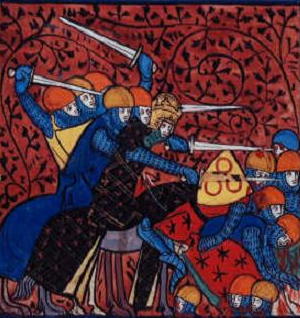
The Seige of Calelleth

Yesterday (see here), I promised to post the synopsis of my book as I continue to work through sections of my proposal. I am pleased to say I got a bit closer to the place I wanted to be, though there is always a (perhaps obsessive) need for the writer to refine and improve.

I have to admit I was a bit depressed by the perpetual mustering of strength  my synopsis required. I was trying so hard and focusing all of my energy on writing a synopsis that is good and gripping and inviting that I nearly tired of writing altogether.

Now, I know it is only a couple of hundred words but I am proud of them. Proud enough to hope that the thrill of finishing this portion of my proposal will be able to carry me through the next. I also hope it offers a potent enough spell to banish that depressive Bob that rears his ugly head every now and again to tell me I’m not cut out for this. You can go to seed, dear friend. This novelist no longer needs you.

Custos is a Humili – both farmer and volunteer in the Calellethian guard. Though war hasn’t happened for centuries, opportunities abound for a young man to display his talent with the sword and bow during the Harvest Celebration. However, before Custos is able to participate, he is chosen to fill a revered post that becomes available once in a generation: The Guardian, the protector of the future Sage of Calelleth.  

After Hailea is elected Sage in Waiting, but before the people of Calelleth discover they are not alone in the world, she befriends her bodyguard Custos and together they uncover a nasty secret buried beneath the city: a labyrinth of passageways leading to ancient ruins and piles of decayed bodies.

As Custos and Hailea struggle with the gravity of this discovery amid the political squabbles and backstabbings that usually encompass their daily life, an innumerable army arrives at the Calellethian gates demanding to have their captive families released to the utter bewilderment of the city leaders.

Will Custos and Hailea be able to devise a plan to appease the ferocious force in order to save Calelleth? Or will the city of Calelleth and its inept army be obliterated by the consequences of a forgotten past?

Keep Writing.

Cheers,

Bob

What Is Your Novel About?

I am having trouble coming up for the synopsis for my book. Funny right? I am the author and even I don’t know what my book is about. It’s not that. It’s just I am having trouble with finding out where my synopsis begins.

My story is one of suppressed histories and nasty secrets that eventually come back to haunt the characters in my book. So, I thought, I should start with the secrets. No, I don’t want to give too much. Should I start with the discovery of the secrets? No, I want that to happen during my novel and not giving it away in its explanation.

I’ve written about twenty drafts of my synopsis. All of them are terrible. I was sitting down in despair because this is a huge part of the proposal. It has to be good enough to capture the agent or reader to spurn them on and create an appetite to continue reading.

My wife eventually said why not start with a quote from my book, something a character says? Or why not start with the beginning of this novel only? I know it seems simple, and it was. Thanks to her I have a great start on description and I will finish it and post it tomorrow.

How about you? Are you having trouble with any particular portion of your proposal? If you’ve written one, what was the most difficult part?

Keep Writing.

Cheers,

Bob

What Famous Writer Do You Write Like?

On many of the blogs I am connected with, there have been posts about, “Who do you write like?” They were interesting reads and I would like to analyze my novel today. I hope you enjoy this post and try it yourself.

The instructions are simple. Merely plug in a portion of your writing and it will tell you who you write like. I figured your writing style changes as you write so I took portions from the beginning, middle, and end of my work. Please visit http://iwl.me/ to try for yourself. It is pretty fun.

Here they are:

Beginning (chapter 1) pg 1 I write like: Gertrude Stein

Middle (chapter 15) pg 197 I write like: Ursula K. Le Guin

End (chapter 30) pg 402 I write like: J. R. R. Tolkien

I guess that is a pretty okay progression.

Why don’t you try it?

Write today.

Cheers,

Bob

C.S. Lewis, On Stories

I like essays. I like essays by any notable writer because it helps me get into their mind, read what makes them tick, and hear what formed their world and life and why this translated into book form.

C.S. Lewis is one of my favorites because he can write something like this:

My dear Lucy,
I wrote this story for you, but when I began it I had not realised that girls grow quicker than books. As a result you are already too old for fairy tales, and by the time it is printed and bound you will be older still. But some day you will be old enough to start reading fairy tales again. You can then take it down from some upper shelf, dust it, and tell me what you think of it – C.S. Lewis’ dedication of the Lion Witch and the Wardrobe.

If you have read any of the Chronicles of Narnia, you will know they are nothing like the Disney film travesties. They are wonderfully written. Read them.

I write this post today because of something I read in a collections of essays by Lewis titled On Stories and Other Essays on Literature edited by Walter Hooper. One of these essays is titled “Sometimes Fairy Stories May Say Best What’s To Be Said”.

It goes like this:

In the Author’s mind there bubbles up every now and then the material for a story. For me it invariably begins with mental pictures. This ferment leads to nothing unless it is accompanied with the longing for Form: verse or prose, short story, novel, play or what not. When These two things click you have the Author’s impulse to complete. It is now a thing inside him pawing  to get out. He longs to see that bubbling stuff pouring into form…This nags him all day long and gets in the way of his work and his sleep and his meals. It’s like being in love.

Crazy huh? Does your work get in the way of your meals? Does it keep you up at night? Well, I think it should and so does C.S. Lewis. If, perhaps, it does not, is it worth your time?

Something to ponder for sure.

Keep writing.

Cheers,

Bob

The 47 Endings of Hemingway

It is a myth that writing comes out perfectly the first time. I don’t think I have ever heard of a writer penning a novel, posting it, and mailing or emailing it off to be printed. I discard and rework almost every part of my writing. Most of the time if I do not like a chapter I rewrite it entirely. I have several drafts of all of the chapters in my book. If I were to go as far as forty seven drafts of a single chapter, I might just have to give up. However, that is exactly what Hemingway did, on ONE novel.

A Farewell to Arms is not my favorite novel. In fact, I am not a huge Hemingway fan at all. His writing is brilliant, but his stories are far to bleak for me. Not that I despise bleakness, my novel ends quite awfully, but its hard to take at times when real life is just as dark.

I wanted to link a post to the article about the forty seven endings to remind the writer how much we have to give to finish well. How much the writer must persevere. How much the writer must refine and how much writing is not just about getting the grammar right.

Find sometime to write today.

Cheers,

Bob

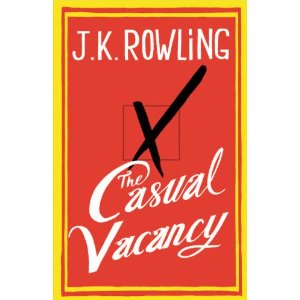
J.K. Rowling’s New Novel: The Casual Vacancy

J. K. Rowling merely sold 600 million Harry Potter books. So, you might ask yourself why is she writing another one? Because her audience grew up. The Casual Vacancy is J. K. first novel for adults.

Here’s a description from amazon.com:

When Barry Fairweather dies unexpectedly in his early forties, the little town of Pagford is left in shock. Pagford is, seemingly, an English idyll, with a cobbled market square and an ancient abbey, but what lies behind the pretty façade is a town at war. Rich at war with poor, teenagers at war with their parents, wives at war with their husbands, teachers at war with their pupils…. Pagford is not what it first seems. And the empty seat left by Barry on the town’s council soon becomes the catalyst for the biggest war the town has yet seen. Who will triumph in an election fraught with passion, duplicity and unexpected revelations? Blackly comic, thought-provoking and constantly surprising

the release date is September 27th and I cannot wait!

Cheers,

Bob

Writer’s Bootcamp: Get Into Writing Shape!

I don’t know much about John Dufresne. I haven’t read anything he has written. But, as I was at the local library on Monday, I went to the writing reference section and checked out some books on writing including his book The Lie That Tells a Truth. I found such wonderful exercises at the beginning I could not help but share. If you like these, you may want to check out his book which is turning out to be a very inspiring and helpful read.

He begins the first chapter which is titled Getting in Shape by asking you to stop reading. Doesn’t that sound a bit odd? Probably not the greatest way to sell books, leaving out the elementary writer’s rule of hooking the reader and all. Then he lists three writer’s exercises which I recommend doing now. They will help you both tone and discover those specific writing muscles we let turn into flab from time to time.

Remember before you begin, remove all distractions. Phone, family, work, email, internet. Remove yourself from everything and dive into the writer’s bootcamp.

1. Here and Now! This is the first exercise. Write about where you are physically. Your writing room, bed, kitchen, outside, where ever. Write in first person, present tense.  Write about what your senses pick up – see, hear, touch, taste, smell. Use each one to create a sensory “image” of where you are right now.

At the end he leaves a handy little quote worth remembering by W.H. Auden – “The first act of writing is noticing”.

2. Something Missing. Evaluate your life. What is it that you wish you had but do not. It could be a relationship, something you lost perhaps an heirloom, or deeper. For instance, something that keeps you awake at night and causes you to wake up in cold sweats. Write about whatever this is and allow it to take form.

3. Where you were born. Think about where you were born, where you grew up. What was it like? How does it defer from where you live now? If you are still there, write about what has changed since you were young.  Where did everyone work? What was the “talk of the town”. How did people talk, walk, or dress? What were the stories of the town, the old building round the corner, the decrepit ice cream shoppe (and why the sign read shoppe and not shoppe)? Write about your school, the places people did not mention, where the uppity people lived, and the haunting secrets buried in that dilapidated mansion over which grey clouds always seem to linger?

Now you’ve written unbridled for thirty minutes. Well done you’ve effectively lifted writer’s weights!

Check out his book. Buy it, or rent it from your library, give your writer’s self a present today. After all, you’ve earned it.

Cheers,

Bob

How Does A Writer Keep Writing?

The start of something new can be invigorating. Whether it is a new beginning at college, a marriage or a move, there are moments in life that leave us full of energy and full of joy, thinking we might literally fly or perhaps, merely climb Everest.

I have felt like that many times with my writing too.That I could sit down and work through the night. My novel would be done and I can move onto the next project I have swirling in my mind. I admire Conan Doyle’s Sherlock Holmes for his unquenchable energy and vigor or the characters in Jules Verne’s stories or the pace at which Dickens can lay down a story for the simple fact that their prose can move so ferociously fast and be so strikingly precise that you cannot help but be swept along by their current.

But what happens when your mind is not abuzz with ideas? When you are trying to drill down for water that just isn’t there to quench your parched aesthetic tongue? Can you simply pick yourself up by your bootstraps and march on? Not if your boots have been stolen.

So how do you continue writing during the dry times, whether in life or in the writing process? How are you encouraged to press and get to your writing implement to churn out more of your novel?


Cheers,

Bob

Effective Writing: By Schedule or By Whim?

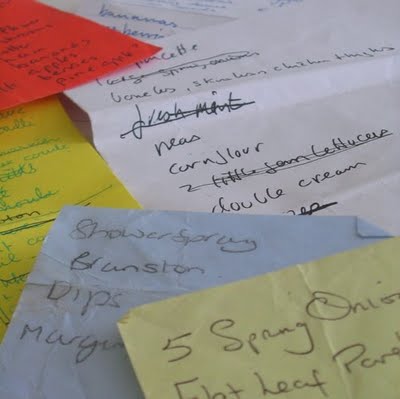
Don’t lose these!

I am a list maker. I live and die by them at home and at work. Sometimes I get sidetracked and provided that the lists do not get lost, they are essential to me to obtain measurable progress and complete tasks.

This translates to writing as well. I jot down ideas for blogs, stories, tangents, and the like to finish later. If I did not, I am sure the stoke of genius (or so I think!) would rush out of my mind just as fast as it invaded. So for me to be a successful writer at this stage of life I have to plan and be intentional. I have to fight for time to write. If I do not it gets crowded out.

This made me think (and perhaps you can do this along with me) about what makes me successful in my writing? Would it be allowing a jolt of inspiration to come tingling into my mind while I least suspected it and then feverishly scratching it on paper, the laptop or any device that spits out sentences? Or rationing out time every day at the same time to plod along, however dull and uninspiring that might seem.

So how about you? Are you better at waiting for the stroke of genius to come, then churning out fifty pages? Or are you better suited to write two pages a day, every day, until your novel is completed?  My suspicion is that when you evaluate the structure of your daily life, or lack there of, you will have your answer.