A Prolific Writer

The writing advice on this blog is learned from my own experience and failures. Lately, I’ve been thinking a lot about how I treat my writing. Am I a slave to it? Do I treat it like a job, as it should be, because I want to do it as a career?

I listened to an interview by James Scott Bell recently and I think it would be helpful for you to hear from him as well. I posted it below. If you have not heard of him he is a best-selling thriller writer. He also has written several books for Writer’s Digest about the craft. I suggest visiting the library and reading a few of them if you want to strengthen your fiction.


Write well today my friends.

Cheers,

Bob

Community in Writing

jotEvery six months, over the last year, my writers group has put on a one night writers conference called Jot. The third installment is less than a month away (Friday, March 14th).

Before we started writing, we were all friends. Each of us had been writing or considering it in one form or another. We each shared our secret love of writing and all of a sudden there we were, meeting about once a week to share our progress or even reading a little of our work. At the time I don’t think we realized the unique situation we had, an organically grown writers group that sprouted out of friendship. We didn’t read an article on a website or an invitation in a bookstore to connect with random individuals, it just sort of happened.

Writing is a lonely activity. I’ve said it many times on my blog that you cannot write alone, but you have to. What I mean is that, just like runners in a marathon, you need people on the sideline cheering you on and also people writing with you to help improve your craft.

The act of writing thrives in community. In community the writer receives encouragement, readers, and challenges all at the same time, three ingredients essential to any would be novelist. This is why we started Jot. Not because we wished to make money (it is free) but because we wanted to connect local writers with other local writers.

If you are a writer in the West Michigan area, or within driving distance, I hope you’ll come out for our event. If anything, our lineup is fantastic. You’ll hear presentations from professional novelists, one on screenwriting, have a chance to attend a free poetry workshop with a poetry editor of a literary magazine, and a presentation from a publisher. I believe, however, you’ll get more than that. Your passion for writing will be ignited and you might find a writing friend or two to meet with regularly, that is our desire.

Writing thrives in community. I hope to see you Friday, March 14th at 7pm at Baker Book House on East Paris in Grand Rapids, Michigan. Until then, write every day!

Cheers,

Bob

Do You Struggle To Find Time To Write?

For various reasons, our books are not done. The task of writing a 60,000-100,000 book is akin to climbing Everest, tomorrow, without any training.

But, let’s break this mountain down.

Writing is about rhythm. Get up every day or writing at lunch or before you go to bed.

If you wrote 400 words a day. (this blog post is 149 words)

You’ll need about 30 minutes. (one less episode of__)

If you do this every single day. (this is your dream remember? show a little tenacity!)

You’ll be done in 250ish days. (100,000 words in less than a year!)

This draft will certainly need some TLC (You have 115 days to plot/edit!)

But it will be done. (And you’ll feel like you can do anything)

Food for thought.

No more excuses.

This is your dream.

Writing is hard work, not dancing in a field of lilies.

Don’t give up.

Write 500 words today.

Cheers,

Bob

I Am Not A Panster

If you ask my wife she would tell you that I am not a detailed person. Most of my friends would say the same. My boss would say I am color blind, but let’s not talk about all my faults at once, okay? I’d like to think I can be detail oriented, but it eludes me. I am a hard worker, tenacious at times, even going without sleep if necessary to complete a task or project. But alas, I have no fine tooth comb. If I ever did, I lost it. Forever.

Panster. When I first heard the term I was confused. Panster, what the? For those of you who have not hear the term it simply means sitting down and writing by the seat of your pants. No plotting or planning, just take a blank page and fill it and move on to the next one. And, though possibly to the ridicule of some, I’d like to say being a panster is not for the serious writer.

Blank pageLiterary giants, and even little ole me, agree that there is a firm rule that there are no rules to the craft. This is true, however, only for the process of getting the book down on the page. You do not follow rules A,B, and C and voila, Dante’s Inferno or the Grapes of Wrath. But I’d like to argue that you also do not sit down with a clear head and there you have the next great American novel or wildly successful YA series. It just cannot happen.

I think it is clear that the two works mentioned above along with most books have a plan, from the beginning. Formulaic or not, the author knows where they are going for the most part. This plan may change and by happenstance or eucatastrophe a beautiful part of the story surprises the author, but only because the other puzzle pieces are laid down. The author knows what size and shape the missing pieces must be in order to make the story work.

Details are not my forte. If you find forming plans too constraining to your free spirit artist, I understand. But keep in mind there must be some form of trajectory. Perhaps not the first draft, so the story is not snuffed out when it is a wee amber, but at some point it will have to be molded into a story. Planning will give your story more of a chance and save you a lot of grief in the editing process.

If you only want barebones guideposts, I suggest you write down the following for each chapter in your book:

Chapter (title)

–          Name of place (or places) this part of your story occurs

–          What the weather is like

–          What characters are involed

–          What would you like to happen. (Write three sentences of your plot)

Do this for each subsequent chapter.

Planning is for the professional, pansting is for practice.

I’d love to hear your thoughts on the topic below.

Find some time to write today!

Cheers,

Bob
Small Victories

Magnofying glassLess than two weeks ago I read a blogpost that mentioned a small press was doing a free critique weekend. I even posted it on my own blog here. A big thank you to Jennifer M Eaton for mentioning it. They would take the first five pages of your work and give you honest feedback, no strings attached. This is not a submission but part of their free critique weekend. I figured I am on a high of finishing my draft and as it is submitted, I could do with a good beating. 

Here’s what they had to say:

Thank you for taking part in our Tender Love Critique Weekend!

Your story starts off with a bang and I must say that I was immediately sucked in, even from just the first five pages! After reading your short sample, I’m curious about the world you have built and eager to learn more about it.

Please find attached your submission, which I have made notes on — one of which is that I caution you to be aware of overused words. You’ll see that I have highlighted frequently used words, which can potentially pull readers out of the story. 

I hope you find my critiques helpful and that when you have finished your novel you consider Lycaon Press/Breathless Press as a potential publisher, as it is our hope to encourage writers everywhere in their pursuit of writing.

Writing is a lonely pursuit at times. It was encouraging to have someone who is not my friend or family member validate my hard work. It was a small victory and sometimes that is all we need to keep going to the next page, to the next word.

Keep writing today friends. That is the only tried and true method of success.

Cheers,

Bob

Reading With A Pen And Notebook

Last week, I was a vandal. Or, at least I felt like one. A local bookstore is in the process of closing its doors and I helped give them a final shove by raiding their shelves. Schuler’s on Alpine Ave was one of my favorite places to go. My wife and I would go there on dates. We took the kids there so much that my when my oldest was one she would always pretend to leave and when we asked her where she was going she always replied, “to the bookstore!” every time.

While I was being a villain, I bought a copy of the book Revision and Self-Editing for Publication by James Scott Bell. It is subtitled Techniques for Transforming Your First Draft into a Novel that Sells. Now, I have never believed that you buy a book, follow its principles, and say hello to a monster book contract. But, I believe that you should always be learning and growing and not become complacent if you want to succeed at the craft.

Mr. Bell loves teaching about writing, this is very plain. One of the first things he did when he was in the process of learning how to write a great novel, is read with a notebook and pen. At first I thought it would transform the pleasure of reading into an arduous experience. I was wrong.

In the opening Mr. Bell talks about his grand scheme to improve his golf game. He decides to by videos, subscribe to magazines and learn all he could about the tips and tricks of the game. Though he did this, it did not help. He got really frustrated and nearly gave up because, though he had the theory down, he could not do it. Learning it was one thing, doing it another. Just as he was about to give up, he met a golf instructor that showed him how simple household items like brooms and coat hangers and the like could help him ingrain the natural movements in golf. Soon, he was better at the game. His body knew how a good swing or putt felt.

This is why reading with a notebook in hand is wonderful. You can write down your own tips as you read your favorite books. You get the feel of a great story or why a particular scene or character is so spot on. I’m reading Harry Potter and the Sorcerer’s Stone and learning why it is so great. I am studying the chapters and the characters. I see the ballon of hope in Harry swell in three paragraphs, a one sentence paragraph plateau, and then three paragraphs tumbling him back to his horrible reality. I’ve learned how the technical part of dialogue and action followed by more conversation. And I’m better at comas.

There are endless things to learn about the craft and Mr. Bell is a great guide for fiction writers. I suggest if you want to get better, read a great work of fiction, and do so with a pen and notebook in hand. 

Cheers,

Bob

Great opportunity! Get your first five pages critiqued by a professional editor

Writing friends, check out the criteria and send your work in. This is not a submission but a free critique. Don’t worry though, this is not an attempt to steal your stuff or trick you, I checked it out. Read full post at Jennifer M Eaton. Good luck!

Jennifer M Eaton's avatarJennifer M Eaton

Dont forget!  today is the big day. Get those pages out there!

Great opportunity! Get your first five pages critiqued by a professional editor.

View original post

Refining Your Fiction

When you first start writing it is all about getting words on the page. When you’ve been writing for a while you begin to stretch yourself to refine these words into a novel, short story, poem or nonfiction piece. There are many ways to do this but one of my favorite ways is to review and replace the words that I use too much.

If you look over your work carefully you will find you default to certain words. Your default words can be anything. Perhaps you are describing a lawn and you always write that it is a lush verdant landscape or you have a constantly roaring sea or roaring villain.

Time and time again I find myself using the same word or phrase and do my best to weed it out of my writing. I want to write good fiction and not have the same rehashed descriptors. It might be a pain to look through my book or short story to kill my darlings were it not for Word Frequency Counter fromWriteWords.org.uk. 

Word Frequency Counter is one of my favorite free tools. Simply copy and paste your work to the box on the webpage and press submit. It does not matter the lenght. I did it with my novel of 90,000 words. It will give you a list of words and you can also search for repeated phrases. Some of the general words are unavoidable like proper nouns or personal pronouns. But as you scroll down you will begin to see the default words.

I’ve provided the link to the website below.

Whatever you do this weekend I hope you look ahead and find some time to write. I’d say don’t kill yourself by staying up late or getting up horribly early but, if you want to get your work done, you just might have to do so! Godspeed my writing friends!

http://www.writewords.org.uk/word_count.asp

Cheers 

Bob


No Matter What, Write Every Day

I wrote in a journal for my first two children every day for the first year of their life. I am doing it for my son now, he’s 6 months old. I love the fact that the last thing I do each day is write and write about something that matters very deeply to me. 

I don’t pretend to be C.S. Lewis in my ponderings, I just try to intermingle my sons daily activities, milestones, and offer advice and thoughts about life. It might not be brilliant, but I hope it shows how much I love my children and how much I want them to have a deep rich life. I love doing something I love and using it in a way to honor my family.

I can also see the benefits of writing every day.

I believe writing is a lot like learning a language. Take the Spanish I used to know for example. While I took classes in high school and college and even went to Mexico and Honduras, now, I can barely bumble through a conversation. Sure it might come back after a while but for the most part it’s gone my friend. 

When I could speak Spanish I was learning and speaking it often. I was immersed in the language. Our creative muscles work a lot like that too.

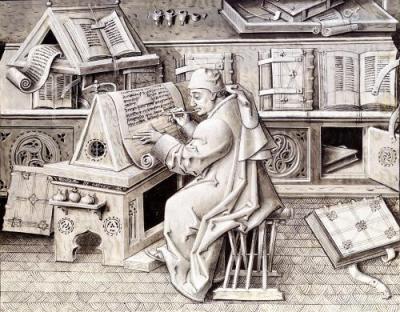
Scriptorium
We have it way easier today

If you can’t find the time to write for a good chunk of time each day, though I’d argue we could all find at least an hour, keep a note pad by your bedside and write each day before you go to bed. Write four sentences. Write a page. Do what you can but do daily so you train your mind and don’t lose those writing muscles. After all, if your goal is to be a writer and to write for a career it might be wise to see if you can both do it and stomach it.

Write 500 words today.

Cheers,

Bob

I Put Writing Last

For the last month I’ve written a total of zero posts on my blog. Those who’ve written books about maintaining a blog say if I want tokeep an audience, you’ve got to keep blogging. Fairly simple idea. The last two months, however, I’ve had to shift my efforts to work and, when I had writing time, to my novel.

I work in sales. I equip accountants and other tax professionals with tax forms, folders, etc. The months of December and January are about 35-40% of my year and tend to get a little busy, brutally so. My appetite to come home and look at a computer screen was sapped by 10am. I like to write and connect with others who share the same dream and passion, but I just didn’t have it in me.

There are times when I feel guilty for taking a break. I shouldn’t be out at a movie I should be writing! I should be writing instead of shopping for jeans! Who needs pants?! These are the thoughts that haunt me when I’m not writing consistently. My passion becomes some horrible guilt ridden flash mob that could strike at any moment.

Thankfully, I learned two things from this break.

1. That I burn bright and fast instead of marching on at an even pace. For those who don’t know me that well, this is nothing new. If I have any goal this year it is to be more pace oriented so I don’t burn myself out all of the time. I’d make me a better husband, father, and person.

2. That I love writing more than I thought. When you get distance from something, it allows proper perspective. You are not as emotionally involved and can be honest. I was and found I craved writing more than I did before my self imposed break. I’m excited to focus on it again.

How about you? Have you put writing down for a bit? What made you go back to it? Are you still not writing? What would it take for you to pick it back up again?

Keep Writing.

Cheers,

Bob