I write alone. No one can write for me. That being said, there are countless people involved in my stories. These individuals read my drivel. They listen to me dream about being a writer and manage to do it without a smirk. They encourage me every step of the way and I would not have written a novel, help start a writer’s conference, published in journals newspapers and websites or started this blog without them.
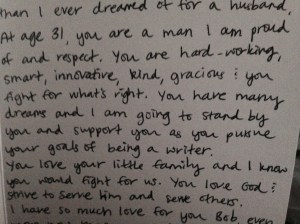
Part of her birthday card to me.
One person in particular has sacrificed more than anyone else: my wife. This week was our nine year wedding anniversary. We’ve “dated” for over 11 years. She didn’t marry someone who wanted to write. I developed the passion about six months afterward.
I write this blog to tell her, that I am so very thankful for her. I’m not always pleasant. I’m certainly not perfect, but she has always been there sacrificing time, correcting grammar, reading and suggesting. So, thank you baby. Thank you for being there. Thank you for not laughing or telling me I’m not good or that I should focus my efforts toward something more practical. In your quiet strength you help me move forward. I could not be here without you.
If you have some one or a group of people who help you in your writing be sure to use your gift of words to say thank you.
Through my interaction with it, I’ve come away with a hundred different ideas. It’s like each paragraph holds four morsels to help tighten up your prose and create books that will continue to ratchet up until the final page.
One of my recent takeaways was to make sure you have a focal point for every scene you write.
Each portion of your work should be directing the audience toward something. What I mean by this is that there is something they are looking forward to, some dangly little cookie that is just in front of their face. Is the character to have a visit from someone? Are they finally going to go through that door? Has your character had enough and it is time to speak up after months of getting trod on? Whatever it is, there needs to be a purpose for each scene, or in other words, the scene’s bull’s-eye.
It’s hard to write a book and be in a fictionalized world and not write for me. In a way I am. I would hope I am entertained at the placing of each word after the next otherwise why would I spend all of this time by myself typing away? But, one thing to keep in mind is that focal point. The place in the distance we are herding our audience. It’s a crescendo that is building and then instead of handing it to them, take it up an octave. This could be an action or a reveal that comes completely out of nowhere.
To take it from Mr Bell –
Every scene in your novel should have a moment or exchange that is the focal point, the bull’s-eye, the thing you are aiming at. If your scene doesn’t have a bull’s-eye, it should be cut or rewritten. Art of War for Fiction Writer’s pg 113.
So as you consider your next chapter – the one with the scene at the café or the grocery store or standing on the parapet overlooking the battlefield, remember, what are you aiming at?
It’s been a while since I participated in the 100 Word Challenge from Julia’s place. I was inspired by my friend Josh’s short story. Read that HERE.
If you want to stretch your writing muscles or are considering working on a large piece of fiction, I’d start here (click on the logo). Confining your words is one of the best ways to develop your language. Limiting your words means you have to pick the right words, or at least the best words you can manage.
This is titled, The Dragon Rider. Enjoy.
Alden Nash touched the Emerald. There was a flash, and he vanished.
Dr. Bulgakov looked around. He heard a faint squeak and saw his friend, a half inch tall now, screaming up at him.
“……!!….!!!!”
“I’m sorry my friend. I can’t understand you.” Dr. Bulgakov replied knowing it was some form of eloquent profanity.
“… said… dragon…rider.” Alden screamed, throwing his fedora down and jumping on it.
“I didn’t. The runes did.” Dr. Bugakov put his on glasses and read the stone tablet again.
“Oh, no.” He looked down. “It says dragon fly rider.”
Think about the last time you failed at a goal. Be it to land a job, run a triathlon, swim a mile, write a book, etc. Whatever it is, it weighs on you. It can be a mocking, dark cloud. You might have failed from lack of effort but those usually don’t hurt. I am talking about one that hurts, and hurts bad. Not a mosquito bite, but a side swipe by a car.
I’ve been side swiped on and off for the last seven years. Okay that might seem a bit dramatic but the stings have been there. I’ve gone through spurts where I have written a lot, and not written at all. This is not what a novelist does, I told myself. Novelists write every single day. They get up and write when they don’t feel like it. They write when they are tired and when they have no effort or words left. Still, they keep laying them down one by one.
I’ve read how Stephen King would spend hours every day finishing his daily word count, Hemingway too. These giants keep/kept a pace of writing deities. I used to think with a little bit of effort, I could do five hundred words a day. But then I’d have a bad day. A day where nothing comes together and my emotions are sapped. I’d given all I could to my family and gladly, but I’d get nothing on the page. There was no more time for artistic pursuits. This was a big issue for me. I’m serious about my work. This is what I want, but I keep failing at measly little daily word counts.
A Realistic Goal
I am reading the Art of War for Writers by James Scott Bell. It is an excellent read and I recommend it to any writer I know. In its pages I discovered something so simplistic I could punch myself for not trying it before (actually I did punch myself): the weekly writing goal.
Instead of walking around feeling like a failure five days a week, because I wrote only two hundred words those days, I’ve decided to aim for a weekly writing goal.
Here are three reasons weekly writing goals work
They are flexible. With a life dominated by the sporadic, I could suddenly lose or gain writing time. Instead of being bummed or paralyzed you can be okay with not writing, or staying up late working toward your goal.
It is a goal. Writers need goals. We need to be working for something. Be it a short story, poem, or novel, there needs to be consistent work and effort. Professional writers, like professional athletes, don’t get to where they are by being lukewarm in their pursuits.
It builds momentum. I wrote 2547 words on my novel last week. I wrote 2 blogs (429, 589 words) and in my sons journal every day. It was nice to continually write. If I had a daily goal, I am sure missing one day would let the air of out my momentum and crush another day with ease. I want to stop that failing feeling.
For my weekly goals, I’ve decided to write:
3000 words on my novel.
2 blogs a week.
1 short story submission per month.
I do all of this while keeping track on a notebook. I always count backward to my goal 3000-0. It’s a physiological thing. Do whatever works for you.
Avoid the power of failure. Set an effective weekly writing goal and don’t compromise. Don’t make it 10,000 words if you don’t have the time and vice versa. Maybe you can only get 1000 words done per week. Whatever your goal is, keep striving and keep writing. If you have goal setting tips, please comment below.
I respect Jon Acuff and thoroughly enjoyed his books. They were inspiration to me and if I had an inordinate amount of money I’d have them all in hardcover. They were water to my creative soul, and gave me drive to work hard and joy at being productive. Unfortunately, I tried to implement one of his suggestions and I failed, utterly.
Around the country there are people who get up and meet at 5am. These people have taken a page from Acuff’s book Start. I don’t recall the official title of these stoic individuals but something like Starters or 5amers comes to mind. Anyway, Mr Acuff says starting early can help your productivity throughout the day. Start goes on to say that it’s easier to do whatever it is you strive to do or be (WRITER!) before the day’s cares and stresses have at you and sap your energy. I wholeheartedly agree with this. If I get up early and pray, read the bible, have a bit of writing time, then enter my day, it is 100% more productive than if I just get up, stumble to the coffee pot and then to work.
You may or may not agree that there are morning people and night owls. They may be subjective terms that mean productive members of society and unmotivated slackers. But how does Mr. Acuff expect me to get up at 5am when I’ve just been up at 2am and 4am with my children? And I won’t even mention my cat. Bandit, I love you, but clawing my face at 3am is not appreciated. Ever had sick kids and be up all night? Try getting up when you are already up. Ouch.
Though it was a huge inspiration, I find myself diverting from a lot of what is said in the book Start to “what works for me whenever it works for me and does not take away from my family time”. I’ve wasted a lot of time looking at what other people do and try to implement their formulas. The thing is I am not them. Their plan worked for them during that portion of their life and got them to where they are today. It might not work for you and me. We might have to find another way.
I was talking with my wife the other day and lamented the fact that I simply cannot count on the morning hours to write, not at this juncture in my life anyway. It has worked in the past, just not now with children this young. She asked me what worked for me and I thought about it. When is the perfect time for me to write?
I‘d like to think of myself as that responsible morning person: get up, make coffee, and put the house in order before anyone is up. I get some exercise in, some writing too, and have an effective morning launch into my day. But maybe I am that slacker night owl that writes until 1am four nights a week.
So for now, I am going to write when I can count on it: when everyone else is asleep and I am awake. Per my wife’s brilliant suggestion, I cleared a shelf next to my bed and bought a 15$ fan to curb the clickety-clack of the keys on my laptop so my wife can sleep.
I guess the idea of Start is to, well, start. Mr Acuff, you weren’t wrong there. Thanks for the inspiration to keep going.
My blog has been dormant for a month now. After the last Jot Conference I came to the realization that I was not growing much as a writer, at least not in the last year. I was writing, and that is always good, but I wanted to get better. I wanted to reach another plateau.
I decided to get back into reading about writing and practicing what I read. I’m reading The Art of War for Writers by James Scott Bell. On the cover it describes the content as: fiction writing strategies, tactics, and exercises.
This book has been a revelation. It’s short, concise, like a daily devotional for the writer. I am reading it through now, and can imagine myself reading a brief chapter before my writing time in the evening.
One of the most surprising things in the book was the emphasis on things other than writing. Of course, Mr. Bell mentions all writers must have a weekly word count goal built into their regimen and other routines the professional writer-to-be must incorporate, but tucked into its pages he also suggests doing things like memorizing a Chopin ballad, play the ukulele, go for a hike, and several other activities that have nothing to do with writing.
Writing is my main hobby. I am working on another novel now and prepping a few short stories for submission, but I was getting burnt out. I gave every free moment I had to writing on my laptop. I work at a desk all day and stare at two computer monitors. I get my fill of screen time and thus it is hard to force myself to come to the computer when the day is done.
However, when it came to free time and I wanted to go for a run, or watch hockey, or just read a book, guilt would creep in. Guilt that I wasn’t getting to my daily word count. Guilt that I was being a slacker and needed to get to work! Honestly, it would eat me up.
This book has given me permission to enjoy my free time a bit more, and to do so without the guilt of not writing. I still write and still think of my novels and short stories all of the time, but it is also good to live, to refill your creative well, and to find joy in things other than writing. I also need to remember to use the revival these things can give and use it as fuel.
Jeff Chapman, a friend and local writer asked me to participate in a blog hop discussing my writing process. Jeff writes speculative fiction that falls somewhere in the fairy tale, fantasy, and ghost story genres. You can read Jeff’s post here. Thanks for the invite Jeff!
What am I working on?
I’ve finished book one of my Seven Sages fantasy series and sent that off to an agent. She is reviewing it now. I have started the second one, and plan to finish that by the end of the summer. I also have a few short stories to submit but I generally write whatever I have a passion for at the time, but I don’t like leaving things unfinished so I don’t allow myself to get distracted from my main project too long. So to make a long story short, one book and a few short stories at the same time.
How does my work differ from others of its genre?
A great question, Jeff! Whenever I hear the word fantasy, I cringe. I immediately think of a bare chested man hugging a snow leopard on the cover. But I write fantasy so yes, this is a paradox. My fantasy has more dialogue and mystery, than sword wielding and battle. Although, these are not missing from my work. I love the works of JRR Tolkien (what fantasy writer doesn’t!) but I also like a good mystery book as well and I’ve tried my best to blend mystery and YA, in a fantasy world.
Why do I write what I do?
From Sir John Mandeville’s Travels cir., 1410
Sometimes the story finds you. I really enjoy history, not just memorizing dates, but works like Fantasy Islands of the Atlantic –stories about Islands that appeared on maps for centuries that never existed. Or 1421 the year China discovered America, and listening to these arguments. I am reading the Travels and Sir John Mandeville, which is an account of a trip from England to Jerusalem all the way to the steps of Asia and the tent of the Great Khan. This account was a complete lie, with mystical beasts and extraordinary tales, but reigned as the authority on countries in the east for centuries. I stumbled across the idea of my book and my world while reading books like these about nine years ago. I’ve been writing short stories and books in this world ever since.
How does your writing process work?
I write whenever I have time. Sometimes that means I bring my laptop into bed and write late into the night. Other times it means I am up at quarter to six to get my words in. As I have three kids under five, anything can happen at any time, so I have to steal writing time to write when I can. My wife is always gracious and allows me to chase my passions. I could not do it without her.
In regards to what I do when I write, I always read the last two paragraphs I wrote before to get a feel for where I need to go. I usually stop writing at a point that is extremely interesting to me, so I have something exciting or interesting to write when I come to the page again. At times I am tired and spent. However , a book does not write itself, and writing is about coming to the page consistently whether you have the appetite or energy for it or not.
Thanks for the invite Jeff.
I’ve asked Josh Mosey to participate I (and a few others I’ll add later). He’s a blogger, flash fiction writer, part of the Weaklings, cofounder of the Jot Writers Conference, and a good friend. Check out his post next week, but check out his blog for now.
Jot is done. The conference was a blast and not because my writers group put it together, but because it was packed, I met several new writers, learned a ton and was encouraged to write. Among the speakers was keynote Tracy Groot. She shared her ideas on pop lit.
I am beginning the next book my Seven Sages series and have a fairly solid idea where I am going with it. I drafted it years ago and split it into two books. Because I already have a good idea of what must happen to get my characters through the book (or sadly lay them to rest), I thought I would examine these six things a little more and see what I can do to make sure my book incorporates them. I started with the first two – the killer first line and the killer first page.
The first line I was thinking of was something like – They were right behind him.
What’s more exciting than starting with a chase scene? Who is this person? What are they running from? I think the luxury of writing a second book in a series is that you already have the characters established. There is growth or change in the people in the book but when you say Thaddeus, or whoever your main character is, the audience already knows who you are talking about. So, you can mess with your audience a bit and really crank up the action.
How about the killer first page? With line one, we’ve already established that there is a chase going on, so what does a good chase scene need? Near misses? Silences followed by loud noises? A character hiding while their pursuer walks slowly past, dragging their feet, as they search inches from the character hiding?
My scene takes place in mysterious wood so why not a near miss, followed by a silence followed by running into a beast that cries out letting his trackers know where he is? I am just playing with this idea now, but let’s face, attention spans are shorter now. We need to do what we can to get our readers invested and down the shoot and into our world as quickly as possible. Action, should not be for the sake of action, it must be important to the story. It must pull our readers in and not let them go. If your book has no need for a chase scene, why not an argument or some other form of intense dialogue to begin the story?
What have your done to make your first line and first page stronger?
There is much more to write, and much more to learn, so off to it.
Hello writing friends. I wanted to inform you of a few last minute details regarding Jot.
The parking lot may fill up quickly. If so, consider parking in the TCBY parking lot instead of the one by La Cantina, unless you want your car towed. This is the safest parking lot nearby.
If you cannot make it, there are two ways to join us:
I’ve read it in writing magazines and on blogs and websites of famous writers that going to writer’s conference is one of the best things you can do if you are serious about being a writer. Writing conferences are part education, part encouragement, and part filler of that elusive creative well.
If you’ve been to Jot, I hope you’ve experienced these things.
Writing can be a lonely process. This is not just true for us amateurs but for professionals too. In the book CS Lewis: Eccentric Genius. Reluctant Prophet., Alister McGrath points out that Tolkien (older and well respected in higher education circles of his day) timidly showed CS Lewis one of his poems he had been working on. Lewis approved of it so enthusiastically, he showed him more. In part, because of that encouragement we now have The Hobbit and the Lord of the Rings. Being around other writers…



 Around the country there are people who get up and meet at 5am. These people have taken a page from Acuff’s book Start. I don’t recall the official title of these stoic individuals but something like Starters or 5amers comes to mind. Anyway, Mr Acuff says starting early can help your productivity throughout the day. Start goes on to say that it’s easier to do whatever it is you strive to do or be (WRITER!) before the day’s cares and stresses have at you and sap your energy. I wholeheartedly agree with this. If I get up early and pray, read the bible, have a bit of writing time, then enter my day, it is 100% more productive than if I just get up, stumble to the coffee pot and then to work.


 PART-TIME NOVEL