Last week I listened to a podcast about creativity. In it writer Jeff Goins and Dr. Keith Sawyer discuss how creative people function and the contents of Dr. Sawyer’s book Zig Zag. One idea they mentioned was that writing or creativity does not have to be perfect. But there should be movement from one project to another.
Besides fear, this is one of the main issues I have with writing. Battling the urge to make a billion tweaks until it reaches perfection versus sending out projects before they are finished is a weekly struggle.
I forget that having a process means that some of my writing will work and some will fail and whatever form of failure I feel is not a reflection of me. Finishing anything – a book, a blog post, a book proposal – is an opportunity to learn how to write better.
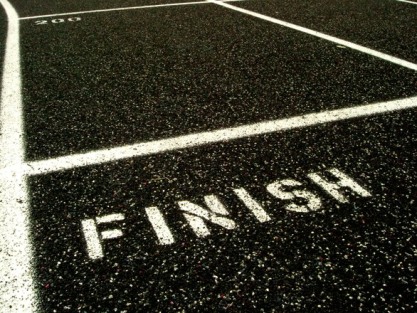
The trouble is that I thought any writing process needed to be straightforward and I have difficulty with linear thinking.
From what I can understand, my mind works sorta like a game of soccer, but played by four and five year olds. It’s scrambly, often working in the wrong direction in a tangle of limbs, sometimes picking flowers, and other moments forgetting the rules entirely.
I decided it was high time to focus. To understand how to get this mind of mine to move through a project from start to finish.
I tried the one project method and ended up bored. I wanted to jump to the next thing as soon as I was stuck. I realized if my methodology incorporated bouncing from project to project then I’d better develop a plan.
Here it is – Finishing is the most important thing.
I devised a Finishing Plan and began using it on my blog and a non-fiction e-book I finished last month. It’s been working great. Here is what it is.
1. Finish a draft. Could take a day, weeks, months, or even years. But finish it. Don’t edit. Write the chapters out of order then fill in the cracks, jump to another idea, then circle back, whatever. Just get it out. Did I mention don’t edit?
2. Edit. I print off what I’ve written (or make a separate edit file electronically) and challenge everything. Make notes, scribble in the margins, destroy darlings, and rewrite. Then get it to a friend or editor for more edits. Then I make the necessary changes.
3. Polish. Add the fonts you love, the appropriate artwork, and anything else you may need to dress up the piece.
4. Send it. Post it, query it, submit it to a journal. Just get it out there, and then move to the next project.
5. Circle back and consider what worked or what didn’t and do more of what did.
This system may seem bare and basic but life is complicated. I also tend to hold onto projects too long and need to get them out there and this process allows me to do that.
Reader, what system do you use? How do you keep moving to the next stage or next project? I’d love to hear from you.
 That may seem like a lot or a little but that is not the point of this post. The point is that since 2011 I’ve had three more kids, written several hundred blog posts, started a writers conference,
  PART-TIME NOVEL