Last week, I was a vandal. Or, at least I felt like one. A local bookstore is in the process of closing its doors and I helped give them a final shove by raiding their shelves. Schuler’s on Alpine Ave was one of my favorite places to go. My wife and I would go there on dates. We took the kids there so much that my when my oldest was one she would always pretend to leave and when we asked her where she was going she always replied, “to the bookstore!” every time.
While I was being a villain, I bought a copy of the book Revision and Self-Editing for Publication by James Scott Bell. It is subtitled Techniques for Transforming Your First Draft into a Novel that Sells. Now, I have never believed that you buy a book, follow its principles, and say hello to a monster book contract. But, I believe that you should always be learning and growing and not become complacent if you want to succeed at the craft.
Mr. Bell loves teaching about writing, this is very plain. One of the first things he did when he was in the process of learning how to write a great novel, is read with a notebook and pen. At first I thought it would transform the pleasure of reading into an arduous experience. I was wrong.
In the opening Mr. Bell talks about his grand scheme to improve his golf game. He decides to by videos, subscribe to magazines and learn all he could about the tips and tricks of the game. Though he did this, it did not help. He got really frustrated and nearly gave up because, though he had the theory down, he could not do it. Learning it was one thing, doing it another. Just as he was about to give up, he met a golf instructor that showed him how simple household items like brooms and coat hangers and the like could help him ingrain the natural movements in golf. Soon, he was better at the game. His body knew how a good swing or putt felt.
This is why reading with a notebook in hand is wonderful. You can write down your own tips as you read your favorite books. You get the feel of a great story or why a particular scene or character is so spot on. I’m reading Harry Potter and the Sorcerer’s Stone and learning why it is so great. I am studying the chapters and the characters. I see the ballon of hope in Harry swell in three paragraphs, a one sentence paragraph plateau, and then three paragraphs tumbling him back to his horrible reality. I’ve learned how the technical part of dialogue and action followed by more conversation. And I’m better at comas.
There are endless things to learn about the craft and Mr. Bell is a great guide for fiction writers. I suggest if you want to get better, read a great work of fiction, and do so with a pen and notebook in hand.
When you first start writing it is all about getting words on the page. When you’ve been writing for a while you begin to stretch yourself to refine these words into a novel, short story, poem or nonfiction piece. There are many ways to do this but one of my favorite ways is to review and replace the words that I use too much.
If you look over your work carefully you will find you default to certain words. Your default words can be anything. Perhaps you are describing a lawn and you always write that it is a lush verdant landscape or you have a constantly roaring sea or roaring villain.
Time and time again I find myself using the same word or phrase and do my best to weed it out of my writing. I want to write good fiction and not have the same rehashed descriptors. It might be a pain to look through my book or short story to kill my darlings were it not for Word Frequency Counter fromWriteWords.org.uk.
Word Frequency Counter is one of my favorite free tools. Simply copy and paste your work to the box on the webpage and press submit. It does not matter the lenght. I did it with my novel of 90,000 words. It will give you a list of words and you can also search for repeated phrases. Some of the general words are unavoidable like proper nouns or personal pronouns. But as you scroll down you will begin to see the default words.
I’ve provided the link to the website below.
Whatever you do this weekend I hope you look ahead and find some time to write. I’d say don’t kill yourself by staying up late or getting up horribly early but, if you want to get your work done, you just might have to do so! Godspeed my writing friends!
Have you ever finished a short story or novel and after reviewing it thought hey, wait a minute, it’s missing that thing. You don’t know what that thing is. It’s just not there. And it can be as frustrating as a strange smell in your house that you cannot locate or understand what is causing it. Then you remember the banana your two year old walked away with the other day and you don’t remember it being in their hand when they came back in the room.
Anyway, the thing, let’s come back to it. After pouring over your recent masterpiece you realize it has no flavor or omph or the secret ingredient that old Italian lady knows for her marinara sauce. It just does not explode on your literary taste buds or get the vote of confidence from your peers you hoped to receive.
I’ll tell you what was missing from my book. Tension and conflict.
Get back here!
I’m sure some of you reading this have felt the same way. And knowing what it is and weaving it back into your story can be as painful and annoying as Peter Pan trying to catch and sew his shadow back on.
If you cannot tell what your book lacks, my guess is that it is probably some mechanical piece of storytelling. My advice to help you find this elusive thing is to ask someone you trust to read it. If you don’t have a writers group, I’m sure you know someone who is an avid reader intelligent enough to understand what needs to be sprinkled in. Be brave. Someone has to read it someday if you are going to be an author.
If you find yourself in this position don’t despair. Don’t give up. Keep reviewing and keep digging. Don’t look for the easy way to publish. You won’t be satisfied with that ending. Put it aside if you have to and come back to it later. After all, a simple steak can be great. But a steak marinated for two days, rolled in a spice blend, and then grilled to perfection will always be better.
Nearly every morning my kids wake up early. When one does, they all do. It’s sort of like a really fun game. Only now when I think about it, it’s not really that fun. There have been times were I’ve stayed up late writing the night before and then get woken up by screams of “MAMA DADDY MAMA DADDY!” Followed by our oldest saying “Mama, I think Clara wants daddy.” I flop out of bed and rescue our middle child from the confines of her crib and head into the dark living room.
I wanted to write this post not because I am a terrible father and want to complain about sleep deprivation, but because I realize I sometimes set myself up to fail with my writing goals. I blame this on Robert Downey Junior, Guy Ritchie, Sir Arthur Conan Doyle, and even a little bit on Margaret Thatcher.
Let me explain.
She does look a wee bit tired.
Before we had kids, there was a time when I woke up at 5:30 to write every Saturday morning. Think about that. I had a good three to four hours all to myself where my thoughts were clear and my mind raced with one brilliant plot line after another (or so I thought). So, when I watched the first Sherlock Holmes film by Guy Ritchie starring Robert Downey Jr., I was immediately enamored by his ability to cast sleep aside and finish a task with a flourish. I thought this must be the best way to produce a novel – write with a feverish, reckless abandon.
The problem with this is obvious. That is Hollywood. That is not real. No one can repel sleep for days while sorting out a problem. They’d go insane. Right? Well, then theirs Margaret Thatcher. Ever read her biography or watched the film Iron Lady? She was a real person (obviously) who supposedly slept four to five hours a night and still ran a country. I’m having trouble with this blog post. Perhaps we are on different plains of brilliance and I need to be OK with that. Or, maybe I am dead wrong with the method that works best at this point in my life.
I find I write best when I am awake. Strange. When I am well rested and have accomplished things during the day I can go downstairs to my desk and write something. My creative well is full from a life lived and a decent amount of sleep. I realize now that instead of staying up late for a few days in a row and then crashing, its best if I sleep for several days in a row then stay up late once. Burning out is not an option. I have a wife to love, children to raise, and a day job.
This might sound simple to you, like a math problem, but I hate math. Reading and comprehension I can do. And to do them successfully, I must be well rested.
How about you? What have you done with your schedule to improve yourself as a writer? Have you ever tested how you work best? Do you stay up all night or do you conserve your energy for a controlled writing burst?
Characters make or break a work of fiction. No matter what perspective you are writing they have to be real, convincing, and unique to survive your entire book.
I’ve read a lot about creating characters. Not so that I can whip up bland cookie-cutter personalities but to learn how to develop them. Our readers want our characters to grow through whatever journey we take them. This does not mean the journey finishes with an end of the rainbow ending, but it does mean that they cannot be the same person at the beginning and at the end.
This is why I believe we should reveal our characters as if they are on a blind date with our audience.
I have not been on a date in about a decade. I’m happily married. But a blind date is a simple enough concept. You don’t start by telling them you are interested in getting married right now, or tomorrow at the latest. And you don’t ask them to see your parents tomorrow or move in. Relationships take time to develop.
Introduce your main characters with a few descriptive details. Not – he was old, fat and lazy. Instead – his hobby was TV, his favorite food was anything found in a gas station, and he kept a fridge next to his sofa so all of his snacks were within arm’s reach.
Okay that description may have been a bit lame but you get the point. Don’t tell the entire history of this person in three or four pages and interrupt the flow of the story. If you do it you, the author, are drawing attention to yourself with this magnificent sidebar. The introduction should feel natural and then take opportunities through the story to reveal the character through action and conversation.
I encourage you to go back and check each time you introduce a character. See how many pages and paragraphs you use to do this. Keeping it short and sweet can help keep your audience in what John Gardner called “the vivid dream”. They will be carried along by the current of your plot as they get to know the people you’ve created.
My friend Matthew is brilliant. Not just because he’s the poetry editor of Structo magazine out of Manchester, UK but because he introduced me to a spectacular function on my new iPhone. While I know the word iPhone can cause people to gag (and wonder if it is actually a word. What does the “i” in iPhone stand for? And why is improper grammar accepted with the spelling of it’s name? For another time “i” suppose) but please don’t hate me. I’m just trying to share a little trick that might help a struggling writer.
I bring up the iPhone today not because having constant access to email and internet distractions is cool but because of the dictate function in the notes app.
Calm down man, you didn’t solve world hunger.
When Matthew mentioned it I was a little skeptical and guessed that it would come out like Spanglish or Frenglish. But thankfully, I was wrong. I can talk much faster than I can type. The main danger, besides the one of phone addiction which many in our world suffer from every day, is forgetting to edit the speak-type (writing like you talk).
This technological sweetness may not seem like a novel idea to you, or of much use, but it has helped me. And that is what this blog is about. Trying to help writers get “there”. I can finish a blog post or talk out some Tweets and then copy them from my email, do a quick proofread and schedule. It frees up a lot of time to do what I want to do, namely, work on my novel.
So my challenge to you is to try it. If you battle the endless war of book vs. platform like I do all of the time, and have a device like mine, this might be for you. You could talk out the post, edit in your free notes app, and email it to yourself for a quick copy and paste to your blog or website. This technology may have been out for years but sometimes I am slow to pick up trends – fashion, gadgety, or otherwise – so please forgive me. But while you are doing that, try it. You won’t be sorry (No, I don’t get a ikickback for this post).
One thing’s for sure. If Mr. Dickens had this technology, he’d probably have taken over the world.
I am amazed by professional hockey players. Of course you think I mean their ability to keep their balance but this is only part of what keeps me in awe. What captures me most is that for all but one month of the year they fill their days with routines of diet, exercise and discipline to be prepared for game time.
Nicklas Lidstrom former Detroit Red Wings Captain
This makes me think of my goal – to be a writer. I want to be a published novelist and I am waiting to hear back from an editor as I write this. But I do not have a routine. My writing time is not consistence and while I do my best to find that time each day, I still struggle with consistency and it shows in many places, especially here on my blog.
So, I have a question for you writer. How are you becoming a professional writer? How are you getting your writing time in, educating yourself and progressing? Books on writing speak of a thousand ways to improve and hundreds of things to consider when putting a book together. But they all settle on one main ingredient that is essential to becoming a novelist – showing up and doing so with consistency.
Today my alarm went off at 5:15am. I decided it was time to create “office hours” for myself to make sure I have writing time every day. I might make this earlier if needed, but I realize the importance of routine. Writing is hard work. Good writing even more so. I think it’s time we roll up our sleeves and get to work.
How about you?
Have you recently made a new dedication to the craft?
We’ve all had it. That eureka moment. The brilliant idea that comes out of nowhere and we just have to get it down. We have seen the story on the blank page in our mind. It’s perfect. Now, to begin…
But how do you begin? How do you place that scene, reveal that secret, or show that one moment that you know your readers will love?
You could begin with narrative. This could encompass a room, a character, a reflection, your protagonist watching an event like a funeral, a board room discussion or parent teacher conference.
But the best question is this: How can you show this scene without simply telling your readers about it? By using dialogue. Beautiful prose is one thing but reading dialogue as the character discovers something sinister, exciting, or euphoric is quite another.
With dialogue your reader is there sifting through sand as the treasure is uncovered or feeling the tension in the conversation just before the shots ring out. Place your reader in the crowd through dialogue rather than telling the reader what the crowd is doing. The tension can be more tense and the thrill that much more thrilling.
Let’s look at these two examples.
The last vestiges of light ignited the mauve colored curtains soaking the room in a soft salmon glow. The rays of colored sun touched the dark mahogany casket, refracted off the gold and silver trimmings, and scattered across the room. In dark corners, where the stray sun beams did not reach, were clusters of family members conversing in whispers. No one party looked at the other and no one looked in the direction of the coffin other than to glare at the executor. He yawned, checked his phone, and wiggled his arm so the sleeve on his charcoal Armani suit rolled down revealing his diamond studded watch. He was obviously waiting for someone to arrive. And though no one said it to him, it was clear as each party followed his glances toward the door, everyone else was too.
What is wrong with this? Not a lot. It describes what is happening well: A funeral for a patriarch that bequeathed his fortune to some unrevealed party. However, it’s dull. How could I make this more interesting and move the story along?
How about use some dialogue instead.
“Did you hear that he spent eighty thousand dollars on a collar for that stupid bloodhound?”
“That’s absurd.” Tabitha said between sips of red wine.
“Is it? What about that desk chair?” Tabitha shrugged. “One hundred thousand dollars for a chair. A chair!” Tabitha looked at the mahogany casket studded with gold and silver trimmings and shrugged again.
“Millie, what’s this you’re complaining about again? You aren’t even blood related.” Millicent inhaled so everyone in the room could hear.
“Charles, my husband is the first born. If there is any honor left in the Lucian family he should be given something. It’s tradition.”
“Millie my dear, I heard he spent it all. There’s nothing left.”
“Hogwash.” Millie hissed. “Then what’s the executor waiting for?”
“That’s not what I heard,” Tabitha whispered. She looked at the clusters of other family members that collected in dark corners of the room and then begged the others in her group closer. “I heard there’s another heir. She’s getting all of it.”
“She?” Millicent barked.
“Yes a girl. And I doubt even she knows about it.”
Each reader has their own taste. Each writer has their own voice and talent to share their tale. However, if your novel is filled with page after page of narrative, I’d encourage you to add some dialogue. This will suck the reader in and not let them wake from the vivid dream you are spinning until you are done.
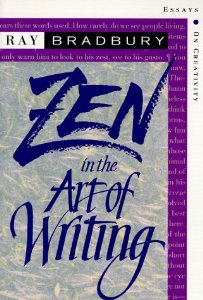
I selected this title because I’ve just finished Zen in the Art of Writing by Ray Bradbury which is a collection of his essays on writing and a few short stories. I don’t know much about Zen, and probably never will, but this book is essential for any writer who is aching for inspiration. If you are caught in the writing Sahara and need an oasis that will fill your creative well and propel you back to the page with a clear head and impassioned desire to write, this is your cool drink of water.
The articles collected in Zen are full of words like: Gust, Zest, and Love. You can almost hear Mr. Bradbury punching the keys of his typewriter as his articles form on the page. There are people you’ve met in life that were full of, well, life. They glow and pour themselves in everything they do. It is clear that this man loved writing and loved life. Writing was not work for him anymore. It was rhythm, beat, song.
The last essay, Zen in the Art of Writing, highlights three words/phrases. Work, Relaxation, and Don’t Think.
Work – Mr Bradbury admits, as do we, that writing is hard work. You not only need to learn the rules of grammar, but those of pacing and timing, plot and character construction, and many more mechanics of a good story. However, there comes a time where you are familiar with your surroundings, like a year or two after starting a new job, and your daily activities become less thought driven. They are natural, almost comfortable. You don’t have to look at the keys any more or learn the “in’s and out’s” of the basics.
Relaxation – It is at this point where relaxation comes in. You have a construct to work inside of and can easily sit down and run through five hundred words that are moderately well written. You’ve paddled out to sea and can now ride the wave inland. You don’t have to think about pacing or what drives your character because it is already there in your mind. But there is more.
Don’t Think – More is truth. We’ve all had the unfortunate experience of being on the receiving end of someone’s unapologetic thoughts. However, this is where good writing lives. You are done paddling out to sea. You are riding the wave. You can now show off your moves. At this point your characters may pull you along like a five year-old at an Easter Egg hunt showing you where all the good stuff is. You don’t have to look for the eggs anymore. Soon enough, you have three short stories and the beginning of a novel you can be proud of.
– Courtesy Wiki Commons
Now, by no means is writing a simple step program. Mr. Bradbury admits that if you write one short story a week, having 52 completed in a year, maybe there is only one good one. But this is the work part. Soon enough you figure out how to write a story and intrigue an audience by your tale.
So writer, stop hoping for that magical time. Stop trying to be perfect or imitate. I ask you, like Mr. Bradbury, to roll up your sleeves and see what happens. It’s time to renew the commitment to your work, to hole yourself up and get a short story completed and submitted. By writing over and over again we can indeed come to something grand.



 PART-TIME NOVEL