One of my friends put this on his blog a few weeks back. Andy, thanks for the introduction to such a great video!
Category: World of Writing
The Best and Worst of Times – Remembering Charles Dickens
I t is fashionable to deconstruct the heroes from our past. It seems that whether they are artisans, musicians, athletes, philosophers, or anyone of remote importance to a body of individuals, once they die, they swiftly become demonized, pompous, or obsessive individuals. This is true if they have just thudded both exhausted feet in the casket or have been dead for quite some time.
The most recent of these scandalized persons is Charles Dickens who turned a very noble 200 on February 8th. Those celebrating his life,death, birth, and works were forced to wade through article after article of critique or gossip turning the beloved author into a mere curmudgeon. Nearly everything I have read about him, recently anyway, proclaims that the “true” Dickens is located in its menagerie of disrespectful words.
While I was at a funeral a few years back I remember the director proclaiming the dead person’s faults to the room of mourning family members and friends. Though this could be deemed proper for those who suffered from the consequences of these faults and they perhaps found some sort of solace in hearing them recanted, I considered it bad form. Part of this was sensitivity to the closeness of the dead person. Part of it is me thinking how I would like it, after struggling through the joys and burdens of life, if someone focused primarily on my obvious faults to the wide world.
Now, our good friend Charles had his own set of troubles. Based on my own readings from the recent issue of the Smithsonian and collection of Dickens’ letters, he struggled through some very dark sins. However, I would like to share with you five reasons that Dickens very well may be the best and most popular author that has ever graced in the English speaking world, and why you should read him to discover why.
1. He is the grandfather of J.K.Rowling. What does Harry Potter and an old dusty Victorian novelist have in common? Their style. The way they construct scenes or the names chosen for characters: Ebenezer Scrooge, Pip, Oliver Twist, Martin Chuzzlewit – is unparalleled. The proof? His books have never gone out of circulation after 150+ years and continue to fly off the shelves.
2. “It was the best of times; it was the worst of times”. These words set off a beacon of familiarity. But where did they come from? Who coined them? Yes, you guessed it, Mr. Dickens in the opening of A Tale of Two Cities.
3. C ountless movies and plays have been adapted from his books or characters.
4. The words. Yes, I know all books have words but take the beginning from A Tale of Two Cities for example:
It was the best of times, it was the worst of times, it was the age of wisdom, it was the age of foolishness, it was the epoch of belief, it was the epoch of incredulity, it was the season of Light, it was the season of Darkness, it was the spring of hope, it was the winter of despair, we had everything before us, we had nothing before us, we were all going direct to heaven, we were all going direct the other way – in short, the period was so far like the present period, that some of its noisiest authorities insisted on its being received, for good or for evil, in the superlative degree of comparison only.
5. Many of his works were serialized (written piece by piece in monthly installments) thus his ability to leave the reader hanging on a ledge is uncanny. Often, a sense of hunger in the reader grows until the climatic end.
There are many more reasons to read him. If you have never delved into the classics, Dickens would be a very good place to start.

Cheers,
Bob
A Writer’s Atmosphere
Recently, I watched A Midnight in Paris staring Owen Wilson and Rachel McAdams. Many people may like the film, but I suspect it has a particularly special allure to writers or artisans. The reason is plain. It is a shuttle of nostalgia, back to a time when a modern awakening occurred in literature and painting alike. Picasso, Dali, Eliot, Hemingway, Stein, Fitzgerald; you name a famous writer/painter who lived during what is referred to as “Jazz Age Paris“, and you would probably find them there (and in the film) at some point or another. It was the place all artists went to ply their trade and were electrified by the presence of each other and the midnight stroll or conversation in such an inspiring place.
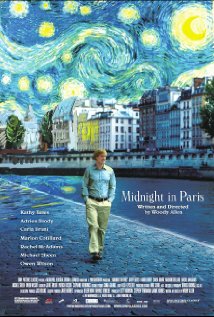
As a writer or artist, do you have a place such as this? We all have writers we look up to or back on. I am sure visiting the places they lived or a lecture by one of them would set us off on such a furiously scribbling fit, that our novels would be finished in mere days. The people I look up to or back toward in my writing nostalgia are The Inklings of Oxford. If I were to meet them, as Owen Wilson did, I may very well have to dig myself a hobbit hole or go on a long stroll in mid January that lasts for scores of kilometers. Or, hope that one day, on the coat tales of that elusive ‘White Whale’ advance, I may one day visit Oxford and The Kilns, especially.
Since, I cannot transport back in time as Wilson did and hand Gertrude Stein my novel to ask her what she thinks or ask father time to turn the dial back several decades to have a chat with Lewis and the gang at the Bird and the Baby, there are other ways you and I must strike onward to create an atmosphere where we are inspired. Perhaps by meeting with fellow writers, discovering new writing blogs and commenting on the posts, attending lectures or classes on the craft, discussing novels with friends and coworkers, or hanging out in beautiful but dusty second hand book shops. In other words, do anything and everything to convince yourself you are apart of this world. A place where only good and worth while stories reside, in other words, your very own Moveable Feast.
 PART-TIME NOVEL